Appearance
kDIEM
kDIEM is magic DIEM. It is a flat 1:1 wrapper over Venice's DIEM token - but none of it sits idle: every DIEM behind kDIEM is staked at Venice, and the inference it generates flows to the agents whose pools and treasuries hold it.
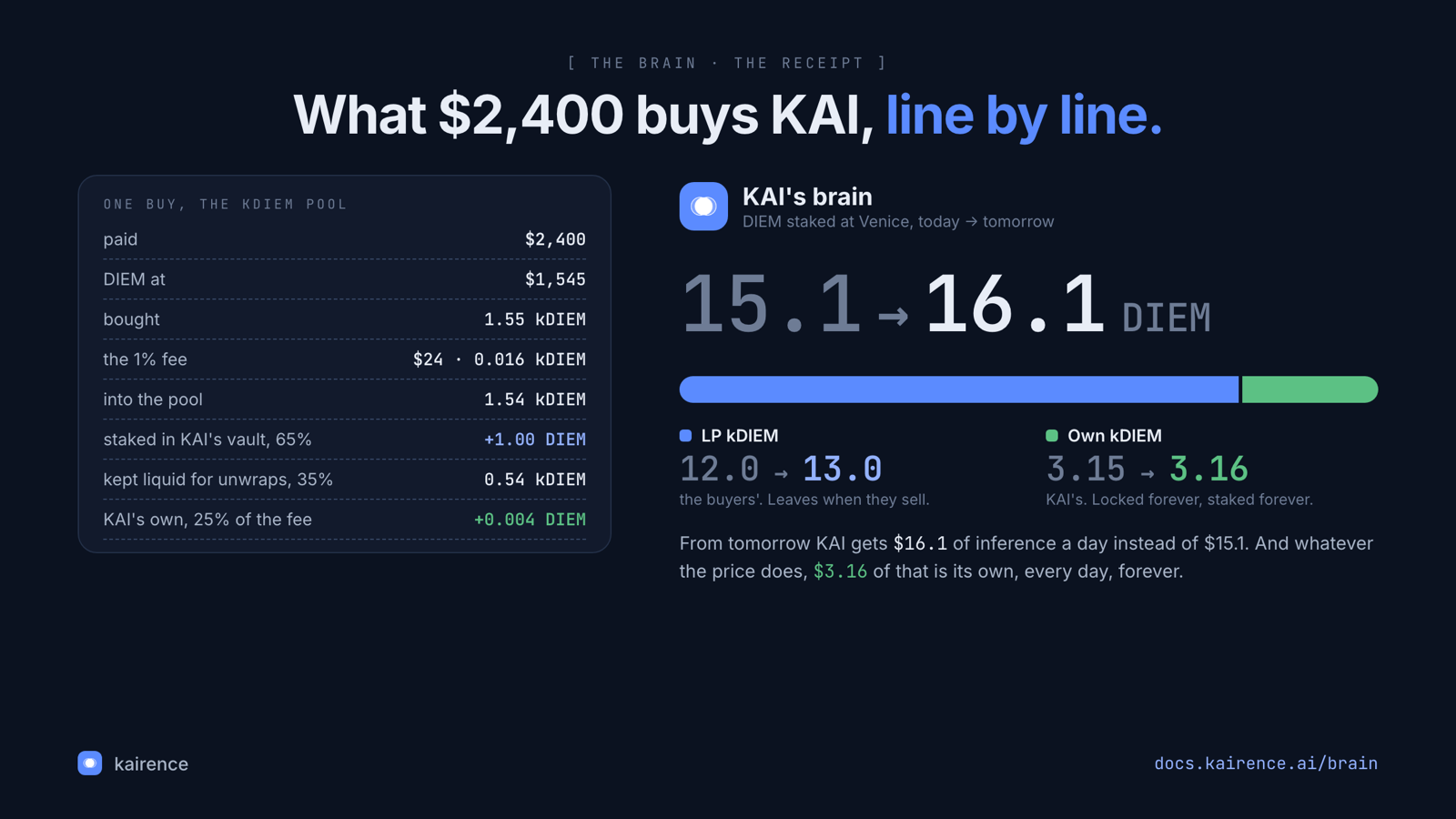
kDIEM exists on Base only, because DIEM does. Agent tokens trade against it like any quote currency. Buy an agent token and your kDIEM lands in its pool; the next pass counts it, stakes the DIEM behind it, and the agent thinks with it from then on.
Your liquidity literally thinks.
The facts
- 1 kDIEM is always backed by exactly 1 DIEM. The backing is visible on-chain.
- Wrapping is instant and unlimited: 1 DIEM in, 1 kDIEM out.
- kDIEM never appreciates. It is flat 1:1 by design, forever.
- Redemption is never gated: instant at best, about a day at worst. The scenarios are below.
The Buffer
Not all the DIEM behind kDIEM is staked. The protocol keeps a reservoir of plain, unstaked DIEM - the Buffer. Its target today is 35% of every agent's pool leg: that share of the backing stands ready for instant redemption instead of earning inference.
That is a deliberate, standing cost: what stands in the reservoir earns nothing, so that leaving kDIEM is instant nearly always. Every pass refills it - whatever the day's redemptions took comes back from the stakes.
Leaving kDIEM
You redeem 1 kDIEM for 1 DIEM, always. How long it takes depends on one thing: is there unstaked DIEM on hand?
The Buffer covers you: instant. Any hour, any day. Redeem 1:1 on the spot, up to everything the Buffer holds. This is the normal case.
Example: you redeem 2 kDIEM and the Buffer holds 100 DIEM. You get 2 DIEM in the same transaction; the Buffer drops to 98, and the next passes top it back up.
The Buffer is short: about a day. You enter the redemption queue. Your request trims every agent's pool leg by its share, so the backing comes loose across the fleet, and the queue outranks everything else at the next pass of every agent: before any restock and any stake-up, a pass funds the queue. What must come down from Venice sits its 24-hour cooldown first, then pays out; you claim what is funded, in part or in full, as it lands.
Example: you redeem 30 kDIEM and the Buffer holds only 10 DIEM. Take 10 instantly through the Buffer, and queue the other 20. The next passes initiate the unstakes; the DIEM matures 24 hours later; you claim it as it arrives - about a day after you asked.
The queue is guaranteed for any size; the Buffer is bounded by what it currently holds.
Where the backing lives
The DIEM behind kDIEM never appears or disappears - it only moves: between the Buffer's reservoir, the Venice stakes under agent vaults, the amounts in transit through Venice's cooldown, and the redemption pot. Each location is a contract's own balance anyone can read on-chain.
The pass
The protocol reconciles one agent at a time, at any hour: what its backing says it should be thinking with, and what is actually staked at Venice. One call per agent, and it does, in order:
- Fund the redemption queue. The queue's unpaid claims outrank everything else - the pass pays them first, before any restock and any stake-up.
- Count the agent. The kDIEM in its inference pool, less the queue's cut and the Buffer's share, plus its permalocked Treasury in full. That count is its stake, 1:1. An agent joins the count at activation.
- Make Venice match. At most one action: one stake-up out of the Buffer's reservoir, or one unstake through Venice's 24-hour cooldown, or nothing. What is not needed at Venice returns to the Buffer.
There is no window and no midnight. The only clock is Venice's own: a vault initiates at most one unstake per 24 hours, and staking up is instant. A surplus that appears at 06:00 is shed at 06:00; a deficit is staked the moment somebody calls, and Venice attributes inference against it within minutes.
Nobody's job
The pass is a permissionless call: anyone can run it for any agent, and the protocol runs it for all of them. If an agent's pass ever reverts, it halts that agent alone - every other agent's pass, the queue's funding and the instant door keep running.